As an Amazon Associate, we earn from qualifying purchases. Some links on this site are affiliate links at no extra cost to you. Our recommendations are based on thorough research and editorial judgment.


3 Best FPV Flight Controllers of 2026: A Comprehensive Guide for Drone Enthusiasts

The three best FPV flight controllers of 2026 include the SpeedyBee F405 Mini Stack, which features a robust six-layer PCB design and integrated Bluetooth for convenient tuning; the HGLRC SPECTER F722 Lite, renowned for its ultra-lightweight build and superior ICM42688 gyro, delivering a 40% faster response rate; and the versatile HOBBYWING XRotor F7 Convertible, equipped with advanced STM32F722 processing. Evaluating their features will further enhance your understanding of ideal selection criteria for efficient flight control systems.
Key Takeaways
- The SpeedyBee F405 Mini Stack offers robust performance and is ideal for competitive pilots with its integrated Bluetooth for easy adjustments.
- HGLRC SPECTER F722 Lite provides ultra-light design and advanced gyro for enhanced stability, perfect for racing and freestyle enthusiasts.
- HOBBYWING XRotor F7 Convertible features versatile installation options and advanced VTX control, catering to serious FPV racing pilots.
- Key factors for selection include flight performance, compatibility with drone configuration, and the number of UART ports for extra components.
- Consider weight, size, and reliability features, such as multi-layer PCB and shock absorption, for optimal drone performance and longevity.
SpeedyBee F405 Mini Stack Flight Controller with ESC
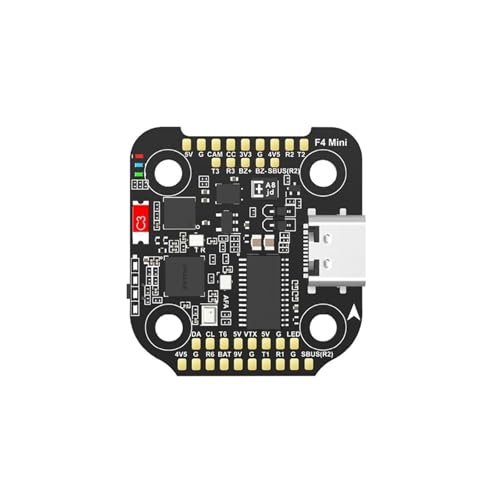
F405 Stack Flight Controller FC BLS 35A V2 3-6S 20x20 4-in-1 ESC Dual BECs for FPV Racing...
- 1.Effortlessly configure your flight controller with plug-and-play installation.
- 2.Stable Performance,Multilayer board design ensures reliable and stable operation during flight.
- 3. The ESC has large space pads to the motors, which makes you solder up your motors more easily and bring a smmothly flight experience
The SpeedyBee F405 Mini Stack Flight Controller with ESC represents an ideal selection for competitive FPV pilots and drone enthusiasts seeking unparalleled performance within lightweight quadcopters. This flight controller features a continuous output of 35A, supported by a robust six-layer, two-ounce copper PCB that guarantees exceptional durability and performance, particularly during voltage spikes and crashes. With integrated Bluetooth connectivity for seamless interaction with the SpeedyBee App, you can effortlessly adjust parameters like PID and OSD without a PC, enhancing operational efficiency. Its dual BEC outputs provide versatile power supply options, further solidifying its status as a premium choice among proficient drone operators.
Best For: Competitive FPV pilots and drone enthusiasts seeking high-performance, lightweight quadcopters.
Pros:
- Exceptional durability and performance during voltage spikes and crashes due to its robust six-layer, two-ounce copper PCB.
- Integrated Bluetooth connectivity allows for easy parameter adjustment via the SpeedyBee App without needing a PC.
- Dual BEC outputs provide flexible power supply options for various components, enhancing overall operational efficiency.
Cons:
- Limited to lightweight quadcopters, which may not be suitable for heavier builds.
- The integrated features may require a learning curve for new users unfamiliar with advanced tuning.
- Potential compatibility issues with certain older components due to the specific BEC output requirements.
HGLRC SPECTER F722 Lite Flight Controller for FPV Drone
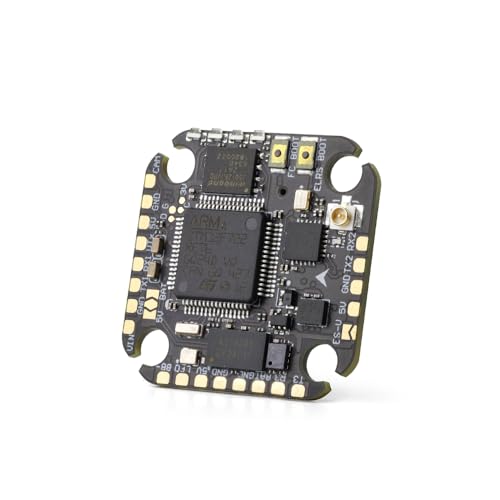
HGLRC SPECTER F722 Lite FC ICM42688 Gyro Integrated ELRS 2.4G Rece iver Flight Controller for FPV...
- Minimal integration: The flight control comes with an onboard ELRS 2.4G rece iver, and an external rece iver is also available. The 4g ultra-featherweight design greatly...
- F722 main control: double-precision floating point acceleration, millisecond-level delay processing flight instructions, and 40% increase in response speed (compared to...
- Full scene adaptation: wide voltage power supply 8.4V-25.2V (2-6S), compatible with light 3-inch whoop to 7-inch long-range drone, eliminating the external BEC module...
For FPV drone enthusiasts seeking an exceptional balance of performance and portability, the HGLRC SPECTER F722 Lite Flight Controller represents an ideal choice, particularly due to its ultra-featherweight design and integrated ICM42688 gyro, which greatly enhances flight stability. The controller utilizes F722 main control technology, delivering double-precision floating-point acceleration with a remarkable 40% increase in response rate compared to the F4 series. Its onboard ELRS 2.4G receiver, combined with compatibility for external receivers, guarantees versatile connectivity. Additionally, it supports a wide voltage range from 8.4V to 25.2V, accommodating various drone sizes, thereby eliminating the need for additional BEC modules.
Best For: FPV drone enthusiasts looking for an ultra-lightweight and high-performance flight controller to enhance their racing and freestyle experiences.
Pros:
- Ultra-featherweight design: Allows for easy installation in compact drone builds.
- High response rate: 40% faster processing compared to F4 series, ideal for high-speed racing.
- Wide compatibility: Supports a voltage range of 8.4V to 25.2V for diverse drone sizes without needing an external BEC.
Cons:
- Limited external receiver options: May restrict connectivity choices for some users.
- Installation complexity: Requires careful integration due to its compact design.
- Specialized for FPV racing: May not be suitable for general drone applications outside of FPV racing.
HOBBYWING XRotor Flight Controller F7 Convertible for FPV Racing
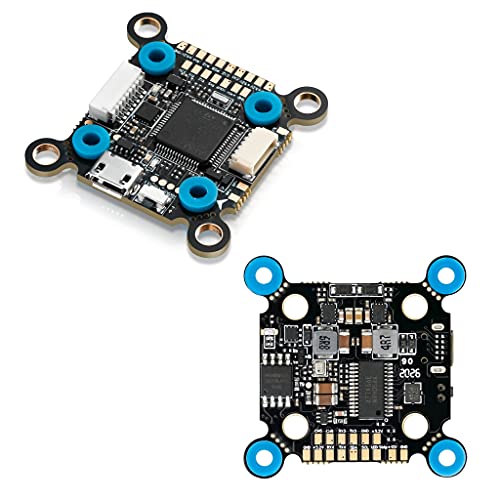
HOBBYWING XRotor Flight Controller F7 Convertible for FPV Racing
- Super hardware and running speed Equipped with STM32F722 MCU
- pecial interface for DJI image transmission system With DJI image transmission system port, equipped with corresponding flat cable (FC has been equipped), can avoid...
- Compatible with 30x30 and 20x20 boards: Perfectly match with Hobbywing ESC Match with Hobbywing tower 4in1 ESC, easy to install and wire. The appearance is more...
Recognized as a vital advancement in the domain of FPV racing technology, the HOBBYWING XRotor Flight Controller F7 Convertible greatly elevates the competitive edge for enthusiasts seeking enhanced performance and adaptability. Featuring the STM32F722 MCU, this flight controller integrates a dual BEC circuit, offering fundamental power for image transmission and 12V LED devices. Its compatibility with various mounting boards, combined with a unique double hole distance design, guarantees seamless installation across diverse frames. Remarkably, the integrated Pit Switch module allows for sophisticated VTX control, promoting user convenience while enhancing shock absorption mechanisms improve flight stability, resulting in precision during competitive racing scenarios.
Best For: FPV racing enthusiasts looking for a high-performance flight controller with versatile features and enhanced stability.
Pros:
- Powerful STM32F722 MCU ensures robust performance and responsive flight control.
- Integrated Pit Switch module allows for convenient VTX control via radio for improved user experience.
- Shock absorption mechanisms enhance flight stability and accuracy, crucial for competitive racing.
Cons:
- Installation may require some expertise, particularly for those new to FPV tech.
- Limited compatibility with non-Hobbywing ESCs, potentially restricting options for some users.
- Higher price point compared to basic flight controllers, which may not appeal to budget-conscious shoppers.
Factors to Consider When Choosing an Fpv Flight Controller

When selecting an FPV flight controller, you should prioritize flight performance capabilities and assess compatibility with your quad configuration to guarantee peak synergy. Additionally, consider the installation and setup ease, as well as the connectivity and tuning options available, to facilitate seamless operation. Finally, weigh the weight and size factors judiciously, as these attributes can greatly affect your drone’s overall performance and maneuverability.
Flight Performance Capabilities
To optimize your FPV flight experience, selecting a flight controller with superior performance capabilities is paramount, particularly amidst an evolving landscape of technological advancements. Consider flight controllers featuring advanced processors, such as the STM32F722 or F7 series, which deliver enhanced processing speeds and superior responsiveness compared to their predecessors. Moreover, prioritize controllers equipped with high-performance gyros, like the ICM42688, as they notably improve stability and precision during complex maneuvers. Additionally, verify the controller accommodates a broad voltage range, ideally from 8.4V to 25.2V, facilitating compatibility across multiple battery configurations. Evaluate options with multiple UART ports to expand connectivity, allowing integration of auxiliary components, such as GPS. Finally, built-in settings for PID tuning facilitate real-time adjustments, thereby optimizing overall performance.
Compatibility With Quads
Selecting an FPV flight controller that seamlessly integrates with your quadcopter’s design and specifications can greatly enhance your flying experience. First, confirm compatibility with your quadcopter’s size; flight controllers vary greatly, accommodating small 3-inch whoops to larger 7-inch long-range drones. Additionally, assess the supported voltage range, as optimal performance necessitates alignment with your battery configuration, typically spanning from 2S (8.4V) to 6S (25.2V). Evaluating the number of available UART ports is essential for connecting peripherals, including GPS, cameras, and video transmitters. Moreover, verify that the mounting dimensions correlate with your frame requirements, as compliance with either 30x30mm or 20x20mm standards is vital. Finally, consider built-in BEC integration to diminish reliance on external power modules, promoting a streamlined setup.
Installation and Setup Ease
While evaluating FPV flight controllers, it is essential to prioritize ease of installation and setup, as these factors directly influence operational efficiency and user experience. Seeking ultra-featherweight designs optimizes installation space, facilitating seamless integration into compact drone frames. In addition, compatibility with various mounting board sizes, such as 30×30 and 20×20, enhances versatility across drone builds. Opt for controllers that eliminate the necessity for external BEC modules, which not only simplifies wiring but also reduces internal clutter. Integrated connectivity features, including dedicated interfaces for image transmission systems, streamline the overall setup process. Moreover, flight controllers with thoughtful design characteristics, such as shock absorption mechanisms in installation holes, greatly improve stability by mitigating external vibrations, hence ensuring superior operational performance.
Connectivity and Tuning Options
Given the rapid advancement of technology within the FPV ecosystem, connectivity and tuning options have emerged as critical factors that greatly influence the operational efficacy of flight controllers. When selecting a flight controller, prioritize models that offer Bluetooth connectivity, facilitating seamless adjustments of PID, OSD, and UART settings via companion apps, particularly beneficial in confined spaces. Additionally, a sufficient number of UART ports allows for numerous peripheral connections, enhancing the overall functionality of your system. Models equipped with dedicated BEC outputs eliminate the need for external modules, streamlining your setup. Furthermore, integrated receiver options, such as ELRS, greatly reduce external components, contributing to cleaner installations. Unique connectivity features for image transmission systems further enhance integration and system efficiency.
Weight and Size Factors
In the rapidly evolving landscape of FPV flight controllers, the interplay of weight and size assumes significant importance in maximizing drone performance and adhering to regulatory mandates. A lightweight flight controller can drastically reduce the overall drone weight, facilitating compliance with the <250g category, vital for competition and legal requirements. Additionally, size considerations dictate compatibility with drone frames; smaller controllers accommodate tighter builds while maintaining essential functionality. Adopting ultra-featherweight designs enhances installation efficiency in compact spaces, allowing for improved flight characteristics, including increased agility and maneuverability, particularly during high-speed racing or freestyle maneuvers. Ensuring that the mounting dimensions align with specified frame measurements, such as 30×30 or 20×20 mm, also guarantees superior performance and secure installation for the controller.
Reliability and Durability
When selecting an FPV flight controller, understanding the nuances of reliability and durability is paramount, as these attributes directly influence the performance and longevity of your drone system. A flight controller capable of withstanding voltage spikes during crashes considerably enhances its reliability, preventing damage to sensitive components. The construction quality, characterized by multi-layer PCB designs with adequate copper thickness, reduces failure risks during intense performance. Additionally, integrated filtering systems, such as TDK filtering caps, diminish electrical noise, thereby improving overall system stability and reliability. Onboard shock absorption mechanisms safeguard high-sensitivity components from external vibrations, increasing lifespan and performance consistency. Furthermore, features like battery indicators enable real-time power level monitoring, preventing unexpected failures due to insufficient power during critical flight operations.
Frequently Asked Questions
What Is the Lifespan of an FPV Flight Controller?
The lifespan of an FPV flight controller typically ranges between one to three years, depending on usage frequency and environmental conditions. In ideal scenarios, where components are maintained properly and not exposed to extreme temperatures or moisture, you may find longevity approaches the higher end of this spectrum. However, rigorous flight settings, combined with frequent crashes and wear, can substantially reduce functional longevity, necessitating timely replacements to guarantee peak performance.
Can I Use Any ESC With Any Flight Controller?
You can’t use just any ESC with any flight controller. Compatibility primarily hinges on communication protocols, such as PWM, OneShot, or DShot, which dictate signal transmission efficiency and responsiveness. Additionally, voltage ratings and current handling capacities of the ESC must align with the power requirements of your specific setup. Consequently, thorough analysis of both components’ specifications is vital to guarantee operational synergy, thereby optimizing flight performance and enhancing system reliability overall.
How Do I Update the Firmware on My Flight Controller?
To update the firmware on your flight controller, first, connect the controller to your computer using a USB cable. Next, download the latest firmware from the manufacturer’s website, ensuring compatibility with your specific model. Utilize software like Betaflight Configurator or INAV Configurator for seamless integration. Finally, initiate the firmware update process by following on-screen prompts, ensuring the update completes fully to enhance performance and system stability, ultimately optimizing your flight experience.
What Tools Do I Need for FPV Flight Controller Installation?
To install an FPV flight controller, you’ll need several essential tools: a soldering iron for secure connections, heat shrink to protect wires, a multimeter to verify electrical outputs, and a screwdriver set for mounting. Additionally, utilizing a bench power supply can guarantee ideal testing conditions. A wire stripper will aid in preparing connections, while a programming tool, such as a USB interface, facilitates firmware uploads, ensuring the system operates at peak efficiency post-installation.
Are Flight Controllers Waterproof or Weather-Resistant?
Flight controllers are typically not waterproof, but several models feature weather-resistant coatings or housings. Approximately 30% of drone enthusiasts prioritize such resilience, ensuring peak performance in variable conditions. When selecting a flight controller, consider factors like ingress protection ratings, which denote dust and moisture resistance. Enhanced sealing and protective measures can prolong operational longevity, addressing concerns associated with environmental exposure, thereby facilitating more reliable functionality during outdoor applications.


