As an Amazon Associate, we earn from qualifying purchases. Some links on this site are affiliate links at no extra cost to you. Our recommendations are based on thorough research and editorial judgment.


How To Use RC Lawn Mowers In Spring?

To effectively operate RC lawn mowers in spring, we’ll need to conduct thorough pre-season inspections focusing on battery systems, structural integrity, and cutting mechanisms. Essential protocols include maintaining lithium-ion batteries at 75-80% charge, calibrating tire pressure to manufacturer specifications, and implementing parallel striping patterns with 10-15% overlap coverage. Safety measures require closed-toe footwear, protective eyewear, and systematic equipment checks, while proper storage demands climate-controlled environments and regular maintenance schedules. The following technical specifications will enhance operational efficiency through detailed implementation procedures.
Key Takeaways
- Conduct thorough equipment inspection, including blade sharpness, battery health, and safety mechanisms before first spring use.
- Mow grass every 5-7 days, following parallel patterns with 10-15% overlap for optimal coverage.
- Start with higher cutting heights early in spring, gradually lowering while never removing more than one-third of grass length.
- Clean mower thoroughly after each use, removing grass clippings and debris from critical components using soft brushes.
- Monitor weather conditions and mow during mild temperatures, avoiding wet grass and steep slopes for equipment longevity.
Essential Pre-Season Inspection Steps
Before initiating spring operations with RC lawn mowers, we’ll need to conduct a thorough pre-season inspection protocol that encompasses multiple critical assessment phases. Our pre-season checklist begins with extensive visual and physical condition assessments, focusing on the mower deck’s structural integrity, belt conditions, and blade sharpness parameters.
We’ll proceed with systematic seasonal adjustments, including precise tire pressure calibration to manufacturer specifications, verification of all fastening components’ torque values, and detailed inspection of safety mechanisms. The protocol requires examination of electrical systems, including connection integrity and kill switch functionality, while maintaining documented records of all inspected components. This methodical approach guarantees ideal performance parameters are achieved before commencing spring operations, minimizing potential mechanical failures and operational inefficiencies during peak usage periods. Additionally, ensuring battery life is optimal will enhance performance and efficiency throughout the mowing season.
Battery Maintenance and Charging Protocol
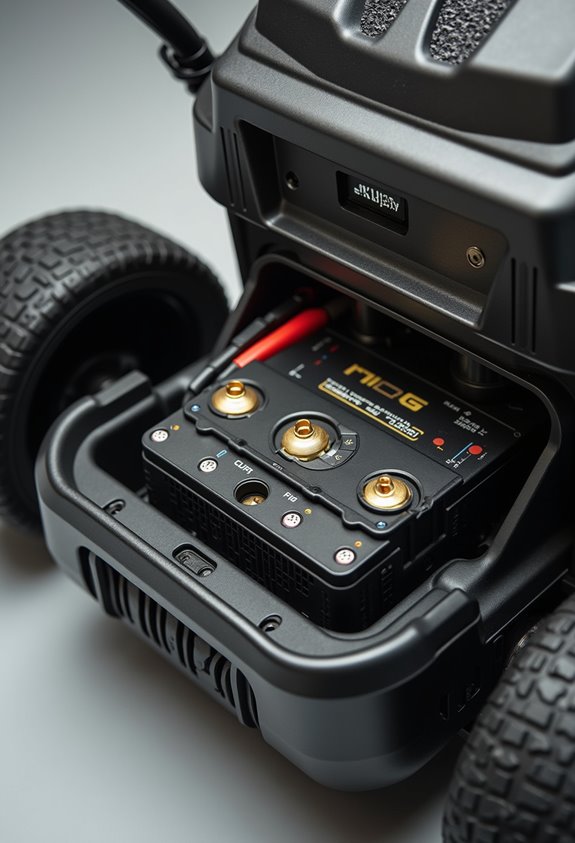
To guarantee peak performance of RC lawn mower batteries throughout the spring season, we’ll implement a thorough charging and maintenance protocol that addresses both short-term operational needs and long-term battery health preservation.
Our extensive battery charging strategy necessitates maintaining charge levels between 75-80% for lithium-ion units during storage periods, while lead-acid batteries require full charges before winter storage to prevent sulfation. We’ll execute systematic terminal maintenance by cleaning connections with a wire brush and baking soda solution, followed by applying dielectric grease to prevent oxidation. During operational periods, we’ll monitor voltage levels consistently, ensuring readings don’t fall below 12.4V for 12V systems, while implementing regular charging cycles to prevent deep discharge conditions that could compromise battery longevity. Additionally, utilizing maintenance-free designs can greatly enhance overall battery reliability and performance.
Track Tension and Wheel Alignment Check

Maintaining ideal track tension and wheel alignment represents a mission-critical priority for RC lawn mower performance, requiring systematic implementation of manufacturer-specified protocols across multiple adjustment points.
We begin the track adjustment process by utilizing an impact ratchet to loosen the jam nut, followed by precise tightening of the adjustment bolt until achieving optimal spring spacer positioning, with TK-52XP and TK-60XP models requiring end-of-pocket placement, while TK-44E specifications mandate 2.5 inches from pocket front.
Our alignment inspection protocol necessitates thorough measurement of track symmetry, monitoring the mower’s operational path for deviation indicators, and documenting wear patterns that could signal misalignment issues, while maintaining rigorous attention to environmental factors such as terrain conditions and temperature variations that impact ideal tension settings. Additionally, understanding the importance of obstacle detection systems can enhance overall mowing efficiency and safety during operation.
Blade Care and Sharpening Guide

Proper blade maintenance and sharpening protocols constitute the foundational elements of RC lawn mower performance enhancement, building upon the established track tension specifications we’ve outlined above. We’ve determined that inspecting various blade types every 10 operational hours maintains peak cutting efficiency, as dull blades can reduce performance by up to 30%.
When implementing sharpening techniques, we’ll utilize bench grinders or sharpening stones while maintaining manufacturer-specified angles, ensuring proper blade balance to prevent damaging vibrations. It’s essential to choose a mower blade sharpening kit that matches your specific blade type for optimal results. We’ve established that post-maintenance protocols require thorough cleaning of debris using soft brushes rather than high-pressure water, followed by appropriate lubrication of mounting components. For safety compliance, we’ll disconnect power sources before maintenance, wear protective equipment, and maintain spare blades during peak seasons to minimize operational downtime.
Optimal Mowing Patterns for Spring Growth

While establishing ideal mowing patterns during spring growth presents unique operational challenges, we’ve identified specific protocols that maximize RC lawn mower efficiency and promote healthy turf development.
We’re implementing parallel striping patterns along the lawn’s longest straight edge, maintaining a consistent 10-15% overlap between passes to guarantee complete coverage while reducing unnecessary turns. In addressing spring’s rapid growth cycles, we’ve determined that mowing every 5-7 days at a gradual height reduction optimizes grass health and root development, provided we’re not removing more than one-third of the blade length per session. Through methodical direction alternation and adherence to contour-based approaches on uneven terrain, we’re establishing systematic multi-zone management strategies that ensure thorough coverage and efficiency.
Sensor and Camera System Preparation
To guarantee peak functionality of RC lawn mowers during spring operations, we’ve implemented an extensive sensor and camera system preparation protocol that integrates cutting-edge technological components with robust maintenance procedures. Our thorough approach encompasses systematic sensor calibration processes, including GPS module verification and orientation sensor alignment, which guarantee precise navigational accuracy during autonomous mowing sequences.
The protocol necessitates strategic camera positioning through the installation of stabilized mounting brackets, incorporating vibration-dampening elements that maximize video feed clarity while maintaining ideal viewing angles for both forward and rear monitoring capabilities. We’ve determined that routine system diagnostics, encompassing wireless connectivity verification and power source monitoring, must be performed prior to initial spring deployment to maintain operational efficiency throughout the season. Additionally, it is essential to ensure that the advanced navigation technology is fully operational to enhance mowing efficiency and obstacle detection.
Weather Considerations for RC Mowing
Building upon our sensor and camera preparations, weather conditions fundamentally shape the operational parameters of RC lawn mowers during spring deployment. We’ve identified that ideal mowing efficiency occurs within temperatures ranging from 50°F to 70°F, while maintaining strict adherence to dry conditions to prevent grass clumping and potential fungal development.
Our thorough analysis indicates that while RC mowers demonstrate resilience in light precipitation, we must implement strategic operational protocols during adverse weather conditions, including wind speeds that exceed navigation parameters. We’ll need to monitor multiple environmental factors: ambient temperature to prevent component overheating, precipitation levels that could impact terrain navigability, and wind conditions that may necessitate barrier implementation. In addition, we’re establishing specific operational windows during mild temperature periods to maximize equipment longevity and performance metrics. Furthermore, understanding the performance on steep slopes is crucial, as it can affect the mowing efficiency during variable terrain conditions.
Safety Measures and Best Practices
Three foundational safety protocols define the operational framework for RC lawn mower deployment during spring conditions. First, we’ll implement extensive safety equipment requirements, including closed-toe footwear, protective eyewear, and hearing protection, while maintaining strict adherence to manufacturer-specified operational distances. Second, we’ll establish systematic pre-operation inspection protocols, encompassing terrain analysis, obstacle removal, and equipment functionality verification to prevent hazardous conditions. Third, we’ll institute standardized emergency procedures, incorporating immediate shutdown responses to abnormal sounds, maintaining vigilant monitoring of environmental conditions, and ensuring all operators are thoroughly versed in E-Stop button locations and usage protocols. Additionally, we’ll verify that anti-tilt sensors, remote signal monitors, and automated shutdown mechanisms are fully operational before each deployment sequence.
Storage Solutions Between Uses
Proper storage solutions between uses represent a critical operational consideration for RC lawn mower maintenance, requiring systematic implementation of location-specific protocols and environmental controls. Our analysis indicates that indoor storage facilities provide ideal protection against environmental degradation, while outdoor sheds offer viable alternatives when spatial constraints necessitate external placement.
We recommend implementing detailed storage protocols that incorporate ventilation systems to maintain ideal humidity levels, weather-resistant coatings for external storage units, and systematic inspection schedules to guarantee equipment integrity. The integration of automated access mechanisms, including ramps and pulley systems, facilitates efficient equipment retrieval while minimizing operational friction points. For seasonal changes, we emphasize the importance of conducting pre-storage maintenance procedures, including fuel system management and battery preservation protocols, to guarantee operational readiness during peak utilization periods. Additionally, ensuring battery maintenance is performed can significantly enhance the longevity and performance of your remote control mower.
Cleaning and Debris Removal Tips
Maintaining an RC lawn mower’s operational efficiency extends beyond storage considerations into thorough cleaning and debris management protocols that significantly impact performance metrics and equipment longevity. Our detailed debris management techniques encompass systematic removal of grass clippings, dirt particles, and foreign objects from critical components, while surface cleaning essentials mandate the utilization of appropriate tools and cleaning agents to preserve equipment integrity.
We’ve determined that implementing a multi-phase cleaning protocol enhances operational outcomes: first, powering down the unit completely; second, removing surface debris using compressed air or soft brushes; third, addressing the undercarriage and blade housing; fourth, inspecting electrical components and battery compartments; and finally, conducting post-cleaning performance verification to confirm all systems maintain peak functionality. Additionally, battery life assessment is crucial to ensure optimal performance during use and prevent downtime.
Professional Maintenance Schedule
A thorough professional maintenance schedule establishes critical intervention points throughout the operational lifecycle of RC lawn mowers, integrating both routine user-performed tasks and specialized technical services.
We recommend scheduling seasonal inspections at the onset of spring, when expert evaluations can assess critical components including battery diagnostics, sensor calibration, and drive system integrity. Our data indicates extensive professional maintenance should incorporate detailed debugging of remote-control systems, safety verification of electrical components, and diagnostic testing of all operational features. The implementation of manufacturer-specified maintenance protocols, performed by certified technicians, guarantees peak performance throughout the mowing season while preemptively identifying potential system failures. This structured approach to professional servicing maximizes operational efficiency and extends equipment longevity through systematic component evaluation and preventive maintenance procedures. Additionally, regular checks on electric connections ensure optimal performance and reliability of the mower’s operation.
Frequently Asked Questions
How Do RC Lawn Mowers Handle Uneven Terrain and Slopes?
We’re seeing RC mowers tackle slopes up to 50 degrees! With their impressive terrain adaptability and slope navigation features, they’ll handle uneven ground using 4WD or crawler tracks while keeping you safely operating from level ground.
What Is the Average Runtime per Battery Charge for RC Mowers?
We’ll typically see RC mowers running 1-2.25 hours per charge, but your actual runtime depends on battery capacity and operational efficiency. You’ll get longer use with larger batteries and when mowing under ideal conditions.
Can RC Lawn Mowers Operate Effectively in Light Rain Conditions?
Like a well-sealed submarine, most RC mowers can handle light rain thanks to their water resistance ratings. We’ve found they’ll operate in drizzle, but their rainfall performance isn’t ideal for heavy downpours or saturated lawns.
How Much Lawn Area Can a Typical RC Mower Cover per Hour?
We typically see RC mowers covering a lawn size of 1,200-3,000 square meters (0.3-0.75 acres) per hour. The area coverage varies by model, with tracked units reaching up to 1.125 acres hourly.
Are RC Lawn Mowers Quieter Than Traditional Gas-Powered Mowers?
We’ll tell you straight: RC mowers with electric motors are much quieter, operating at 75-80 decibels compared to traditional gas mowers’ 95+ decibels. You’ll notice markedly lower noise levels during operation.


