As an Amazon Associate, we earn from qualifying purchases. Some links on this site are affiliate links at no extra cost to you. Our recommendations are based on thorough research and editorial judgment.


Is AI Technology Changing FPV Racing?

AI technology is radically transforming FPV drone racing through autonomous systems that consistently outperform human pilots by margins exceeding half a second, while achieving speeds of 95.8 km/h. We’re witnessing deep neural networks enabling split-second trajectory calculations and real-time decision-making through sophisticated onboard processing systems, which communicate directly with motor controls. Through simulation-to-reality training protocols and advanced stabilization technologies, these AI-powered drones are setting new competitive benchmarks that reveal the future of professional racing.
Key Takeaways
- AI-powered racing drones now outperform human pilots, achieving speeds of 95.8 km/h with superior maneuverability and faster decision-making capabilities.
- Deep neural networks enable real-time processing of visual data and instant trajectory calculations, revolutionizing how racing drones navigate courses.
- Racing dynamics have evolved into a hybrid model combining AI strategy with human tactical execution, shifting focus toward technical expertise.
- AI systems enhance safety through improved obstacle detection and adaptive flight algorithms while maintaining peak racing performance.
- Autonomous racing drones process complex environmental data through simplified sensor arrays, setting new competitive benchmarks in trajectory planning.
The Rise of AI-Powered Drones in Racing
As technological advancements continue reshaping competitive drone racing, we’re witnessing an unprecedented integration of artificial intelligence systems that are fundamentally transforming the sport’s landscape. Autonomous racing drones now process complex visual and inertial data in real-time through onboard AI systems, demonstrating remarkable efficiency in navigation and decision-making without external positioning infrastructure.
We’re observing a paradigm shift in AI perception capabilities, where single forward-facing cameras replicate human FPV piloting experiences while deep neural networks communicate directly with motor controls. The integration of simulation-to-reality training protocols has enabled AI systems to master intricate maneuvers before physical deployment, resulting in performance metrics that increasingly challenge human competitors across international competitions featuring over 210 participating teams. Additionally, advanced stabilization technologies equip these AI-powered drones with enhanced control, making them formidable contenders in the racing arena.
Recommended Products

[True 360° Immersive Flight] Experience the Vision Goggles' massive 90° FOV, 66% wider than standard goggles*, with dual 1-inch Micro-OLEDs and Pancake optics that deliver uncompromised 2560P immersion. Its lightweight, 340g design with built-in diopter adjustment ensures a sharp, glasses-free view for every pilot.

True 360° Immersive Flight: Experience the Vision Goggles' massive 90° FOV, 66% wider than standard goggles*, with dual 1-inch Micro-OLEDs and Pancake optics that deliver uncompromised immersion. Its lightweight, 340g design with built-in diopter adjustment ensures a sharp, glasses-free view for every pilot.
Breaking Speed Records: AI Vs Human Pilots

Recent head-to-head competitions between AI-powered drones and human pilots have definitively demonstrated AI’s superior performance capabilities, with autonomous systems achieving unprecedented speeds of 95.8 km/h while maintaining exceptional maneuverability.
The quantifiable AI advantages manifest primarily through deep neural networks enabling split-second decision-making and ideal trajectory calculations, resulting in consistently superior performance metrics, particularly during race starts and tight cornering sequences. While human intuition remains valuable in certain track segments, empirical data from international competitions, including the A2RL Drone Championship and Falcon Cup Finals, demonstrates AI’s decisive competitive edge, with autonomous drones outperforming former DCL world champions by margins exceeding half a second. This performance differential persists despite operational constraints, including single-camera configurations and limited computational resources. Moreover, the integration of advanced flight stability features in AI drones significantly enhances their control during rapid maneuvers, contributing to their overall success on the racing circuit.
Deep Learning and Real-Time Decision Making
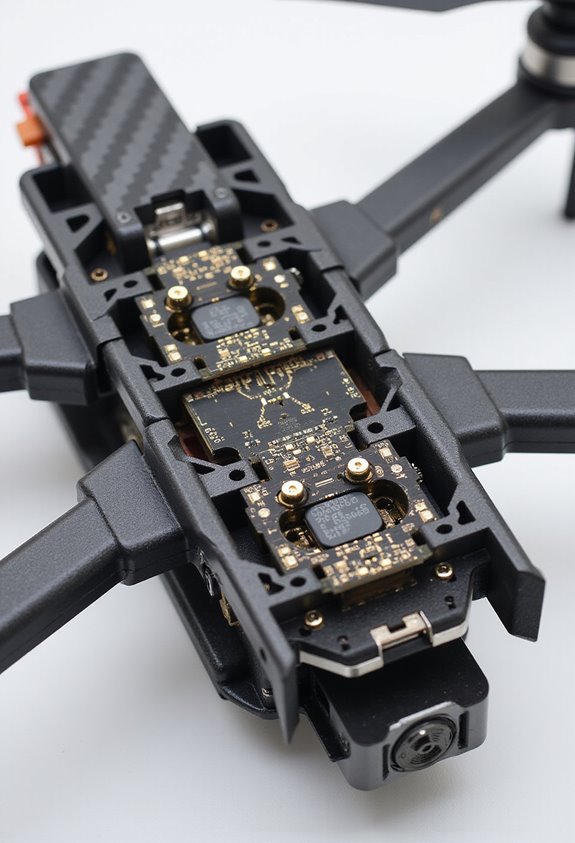
Deep learning’s transformative impact on FPV racing has revolutionized real-time decision-making capabilities through sophisticated neural networks that process high-speed video feeds at unprecedented rates. Our integration of real-time analysis systems enables autonomous drones to execute complex maneuvers while detecting gates, tracking trajectories, and responding to environmental changes with microsecond precision.
We’ve observed that decision algorithms, when combined with visual attention prediction models, demonstrate remarkable adaptability in handling dynamic race conditions, including occlusions and motion blur. Through high-fidelity simulations and imitation learning protocols, these systems now process visual data streams with an efficiency that rivals human pilots, while maintaining consistent performance across multiple laps. The hybrid integration of AI with traditional control methods has established a new paradigm in racing automation, optimizing both stability and speed parameters. Additionally, the implementation of advanced flight controllers significantly enhances the responsiveness and precision of these autonomous systems, allowing them to react more effectively during races.
Recommended Products


Experience the Thrill of Flying: Enjoy total immersion and intuitive control with DJI Avata. When you combine Avata with the goggles and motion controller, flight becomes accessible to all..Shutter Speed : Video: 1/8000-1/50 s, Photo: 1/8000-1/50 s. Video Format : MP4. Diagonal Distance : 120 mm.

Unlock Adrenaline-Pumping Immersive Flying - Prompt visual feedback through goggles as if you were right there in the cockpit, enjoying a breathtaking perspective, pure thrill and total freedom.
Hardware Evolution in FPV Racing

Through remarkable technological breakthroughs in miniaturization and materials science, the hardware evolution in FPV racing has fundamentally transformed competitive drone athletics over the past decade.
The integration of advanced hardware advancements, including high-torque motors and digital video transmission systems, has enabled unprecedented levels of speed and maneuverability in racing environments. We’re witnessing considerable improvements in drone materials, with manufacturers implementing aluminum frames and injection-molded components that notably reduce weight while maintaining structural integrity. The implementation of sophisticated electronic speed controllers and enhanced flight control systems has revolutionized precision handling, while high-resolution FPV goggles operating at 1920x1080p resolution deliver immersive pilot experiences. These technological developments, coupled with modular design approaches and aerodynamic optimizations, have established new performance benchmarks in competitive drone racing. Additionally, sophisticated stabilization features have become essential for ensuring clear footage and maintaining control during rapid maneuvers.
Recommended Products

【Unmatched Power & Efficiency】The FPV motor features ultra-pure copper windings, a 0.2mm silicon steel stator, 200°C high-temperature enameled wire, multi-strand winding, and a vacuum-pressure impregnated (VPI) process for maximum insulation. It delivers rock-solid performance in harsh environments from -40°C to 80°C (-40°F to 176°F).

[Premium Flight Controller with Enhanced Stability] Experience precision control through the advanced F722 processor and industry-trusted gyroscope technology, ensuring ultra-responsive handling for competitive racing scenarios.Integrated black box storage captures critical flight data for performance optimization.

The aneegfpv ECO II 2807 6S Series is a new and very powerful FPV motor for FPV racing, focusing on quality and performance for maximum durability and higher performance.
Transforming Race Strategies and Competitions

As artificial intelligence revolutionizes competitive drone racing, we’re witnessing unprecedented transformations in race strategies and competition dynamics that fundamentally alter the sport’s trajectory. The integration of AI-driven optimization has established new competitive benchmarks, with autonomous systems consistently outperforming human world champions in trajectory planning and execution.
We’re observing a significant strategy evolution through AI’s capacity to process real-time environmental data and make split-second adjustments, while maintaining precise control through complex race circuits. The race dynamics have shifted toward a hybrid paradigm, where AI systems provide strategic optimization while human pilots focus on tactical execution. This technological progression has elevated FPV racing to a more technical domain, attracting participants with expertise in robotics and artificial intelligence. Furthermore, the incorporation of BEC voltage regulators ensures that drones maintain stable power supply during intense competitions, contributing to overall performance reliability.
Impact on Professional Racing Circuits
While professional racing circuits have historically focused on human skill and reflexes, the integration of AI technologies is dramatically restructuring competitive dynamics across formal drone racing events. We’re witnessing autonomous drones consistently outperform champion human pilots through precise trajectory optimization and split-second decision-making, fundamentally altering traditional racing paradigms and performance benchmarks.
The emergence of AI competitors has prompted substantial regulatory challenges as leagues adapt their frameworks to accommodate both human and machine participants, while simultaneously leveraging AI-generated operational data to enhance circuit design, safety protocols, and race standardization. We’re observing racing organizations, particularly the Drone Racing League, diversify their event formats to include AI vs. human competitions, requiring updated technical standards and transforming conventional broadcast experiences to showcase technological advancement alongside athletic achievement. Additionally, timing belt pulleys are increasingly being utilized in drone technology to improve mechanical transmission efficiency and enhance overall performance.
Safety and Performance Advancements
The integration of AI-powered safety protocols and performance optimization systems has revolutionized FPV drone racing’s operational parameters, yielding unprecedented advancements in both accident prevention and competitive capabilities.
We’re observing remarkable safety innovation through AI-enabled sensor arrays that deliver superior obstacle detection and real-time adaptive flight algorithms, while performance metrics demonstrate that autonomous drones consistently outperform human pilots in speed and precision. The implementation of deep reinforcement learning has enabled drones to optimize flight paths and maintain peak physical limits, with neural networks facilitating faster actuation and tighter maneuvering beyond human capabilities. Additionally, AI-driven race management systems now analyze live telemetry and predict track conditions, establishing a thorough framework for proactive hazard prevention and enhanced competitive integrity across professional racing circuits. Furthermore, the use of high refresh rates in modern drone receivers has significantly improved communication, enabling quicker response times during races.
Recommended Products

Unlock Adrenaline-Pumping Immersive Flying - Prompt visual feedback through goggles as if you were right there in the cockpit, enjoying a breathtaking perspective, pure thrill and total freedom.

Experience the Thrill of Flying: Enjoy total immersion and intuitive control with DJI Avata. When you combine Avata with the goggles and motion controller, flight becomes accessible to all.

DJI FPV FLY MORE KIT: It is designed for those who want to extend and guarantee the flight time of their drone, thanks to the two smart batteries and the multiple charging station included
Beyond the Racetrack: Commercial Applications
Racing technology’s rapid evolution into commercial sectors has catalyzed transformative applications across multiple industries, with AI-enhanced FPV drone systems now delivering unprecedented operational efficiency and cost reduction capabilities.
We’re witnessing widespread adoption across diverse sectors, as drone inspections revolutionize infrastructure maintenance through thermal imaging and autonomous navigation in hazardous environments, while agricultural monitoring systems leverage multispectral analysis for precision farming and crop optimization. The logistics optimization sector has demonstrated significant cost reductions through AI-driven route planning and automated package delivery, as entertainment content creation benefits from advanced stabilization and tracking capabilities. Additionally, the integration of FPV technology enables enhanced environmental tracking of wildlife and deforestation patterns, while security surveillance applications leverage military-grade target recognition and swarming capabilities for thorough threat assessment and response. Moreover, the high-quality imaging systems in modern FPV drones significantly enhance the data collection process, making it easier to analyze and act upon gathered information.
Recommended Products

【US Local Service Support Team】: ①If you damaged your drone, we always offer low-cost replacement parts in our store & Local warehouse ②We keep upgrading the APP and Tablet system for more Features, KEEP AWAY FROM TREES FOR DRONE SAFETY! AVOID CRASHING TREES. ③Bingchat offers one year quality free replacement support along with 3 years flight quality support. ④Based on our trusted after-sale support, our awesome drones have a high repurchase rate and referral rate from our customers

Unlock Adrenaline-Pumping Immersive Flying - Prompt visual feedback through goggles as if you were right there in the cockpit, enjoying a breathtaking perspective, pure thrill and total freedom.

✅ Made for First-Time Flyers – Professional Results: EZ Pro makes flying easy even if you’ve never touched a drone. With AI-assisted flight and auto-stabilization, you’ll capture stunning aerial shots with zero stress.
The Future Landscape of AI Drone Racing
Building upon the commercial sector’s transformative applications, AI drone racing‘s future trajectory promises unprecedented technological convergence and competitive evolution, as evidenced by groundbreaking developments at the 2026 A2RL Drone Championship.
We’re witnessing a paradigm shift in race complexity, where future tracks will incorporate dynamic obstacles and mission-style challenges, necessitating advanced AI systems capable of real-time adaptation and split-second decision-making. Strategic drone partnerships between technology firms and racing organizations are accelerating the development of lightweight AI systems that can process complex environmental data through simplified sensor arrays, particularly single forward-facing cameras. As reinforcement learning algorithms continue to evolve, we anticipate AI drones will push beyond their current 95.8 km/h speed threshold while simultaneously mastering the intricate balance between velocity and precision. Additionally, the integration of advanced safety features in drone technology will further enhance the reliability and performance of racing drones in competitive environments.
Frequently Asked Questions
How Do Weather Conditions Affect AI Drone Performance Compared to Human Pilots?
While AI often excels in weather adaptability, we’ve found human pilots still handle unexpected turbulence better. Yet, AI’s consistent performance isn’t affected by pilot interference like fatigue or stress during harsh weather conditions.
What Happens if an AI Drone Loses GPS Signal Mid-Race?
When GPS fails, we’ll see AI drones use recovery strategies like secondary tracking and autonomous vision systems. They’ll rely on alternative navigation methods, but there’s still a higher risk of crashes or disqualification.
Can AI Drones Learn From and Adapt to Different Pilots’ Racing Styles?
We’re witnessing AI drones become our personal racing mimics! Through pilot adaptability and style recognition, they’re absorbing our unique techniques, though it’s still early days in teaching them our daredevil racing personalities.
How Do Spectators Distinguish Between Ai-Controlled and Human-Piloted Drones During Races?
We can spot AI drones through their distinctly precise movements, enhanced spectator engagement displays, and unique drone aesthetics. They often follow smoother paths and lack the visible human pilot on racing grounds.
What Maintenance Requirements Do AI Racing Drones Need Compared to Traditional Ones?
With AI drones reducing maintenance time by 40%, we’re seeing major shifts in drone maintenance needs. They require more technology upgrades but fewer manual inspections, while traditional drones need regular hands-on checks and repairs.


